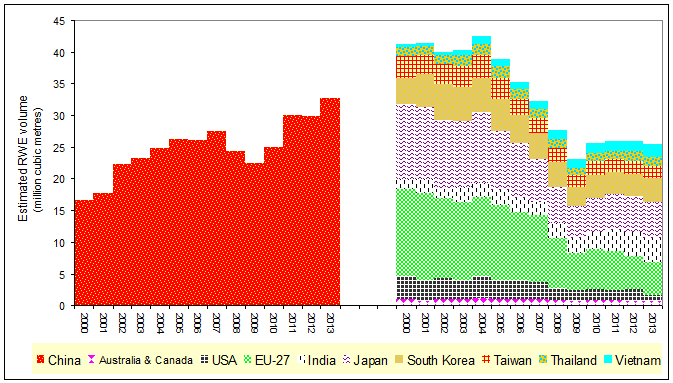
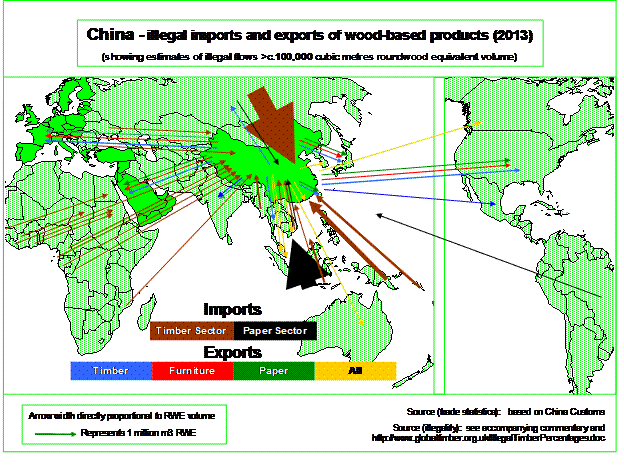
|
Note
This analysis should be treated as a first iteration towards quantifying
the order of magnitude of illegal wood-based product trade to and
from China.
It clearly shows
the probable importance of the USA as a market for illegal wood-based
products and begs questions about the actual intent of the US President's
"Initiative
against Illegal Logging" - which, although in many ways welcome
- does not appear to seek to address the USA's own illegal imports
(and its role in driving illegality).
The analysis indicates
that the import value of the illegal wood-based products which the
USA is likely to import from China alone during 2006 is in the order
of US$3.5 billion (mainly attributable to wooden furniture), roughly
200 times greater than the sum allocated to the USA's initiative against
illegal logging initative.
During 2006, China
was probably the world's
leading importer of illegal timber and one of its principal suppliers
of illegal timber.
China - illegal
imports
A high proportion of China's
imports of wood-based products are associated with illegality
- here defined as "in conflict with either the letter or intent
of the law or otherwise associated with corrupt practice".
Neither the State
Foresty Administration nor the Ministry of Commerce appear (willing
or) able to take responsibility for the manufacture and trade of illegal
wood-based products. The clear and increasing weakness of Beijing
relative to local government is a major handicap to both these institutions.
The following
percentages are based on those which are estimated in "Which
10 Bilateral Flows Have Most Salience to International Effort Against
"Illegal Timber"? They pertain solely to China's (production
and imports) in 2007 - other percentages might be approriate in other
years or for other importing countries. Indeed, China's imports from
any given country are likely to contain a greater proportion of Illegal
Timber than any those of other importing country.
Brazil: 70% (China's
focus is almost entirely on tropical timber)
Burma:
>90% (very large mismatch between official exports and declared
imports; national law is in abeyance)
Cambodia: 100%
Cameroon:
80% (primarily logs)
China:
40% (production in excess of quota and other unaccounted production
[Table
9] and [p4])
Congo
(Brazzaville): 90% (flagrant disregard for the law, including
by the country's current ruler in the granting of concessions;
China's primary interest is logs but the law seeks processing prior
to export)
Equatorial
Guinea: 90% (flagrant disregard for the law concerning maximum
allowable cut and de facto concession size attributable to
one company (and its sponsors) which supplies most of China's imports)
Gabon:
80% (flagrant disregard for the law - China's primary interest is
logs but the law seeks processing prior to export; tax not paid on
two thirds of area allocated as forest concessions)
Guyana:
60% (flagrant disregard of forest policy concerning local processing
prior to export; absence of management plans; logging other than by
the legal concessionaire)
Indonesia
(timber): 90% (mirror
statistics indicate that customs fraud is apparent mainly in respect
of supplies to China - justifying an increase above the 83% rate of
illegal logging in natural forest)
Indonesia
(pulp and paper): 90% (much pulpwood from natural forest; primarily
from fraudulently financed mills)
Malaysia:
40% (primarily from Sarawak - improperly allocated concessions; illegal
timber from Indonesia)
Mozambique:
80% (assuming Zambézia province is typical; log exports discouraged)
Papua
New Guinea: 90% (surge in China's imports has undermined efforts
to improve governance in the sector)
Russia
(timber): 60% (absence of law enforcement, forest frontier moving
west as resources become exhausted, pressure to maximise imports before
application of log export tarrifs)
Russia
(pulp and paper): 10% (FSC-certified supplies from Ilim's
Bratsk mill for International Paper account for most of China's
imports of pulp from Russia)
Solomon
Islands: 90% (China
accounts for the great majority of the excess over Annual Allowable
Cut)
| China -imports of wood-based products
(2007) |
Logs
|
Sawn wood
|
Plywood
|
Wood-based pulp
|
Paper
|
Timber sector
|
Timber sector
|
Paper sector
|
|
|
|
|
(million cubic metres)
|
(million tonnes)
|
% illegal
|
mi m3 RWE
|
mi m3 RWE
|
mi m3 RWE
|
| Brazil (tropical) |
|
0.3
|
|
|
|
15%
|
0.1
|
0.2
|
|
| Burma |
0.7
|
0.3
|
|
|
|
20%
|
0.2
|
1.1
|
|
| Cameroon |
0.2
|
|
|
|
|
30%
|
0.1
|
0.2
|
|
| Congo (Brazzaville) |
0.3
|
|
|
|
|
30%
|
0.1
|
0.3
|
|
| Equatorial Guinea |
0.5
|
|
|
|
|
30%
|
0.1
|
0.4
|
|
| Gabon |
1.1
|
|
|
|
|
30%
|
0.4
|
0.9
|
|
| Indonesia |
|
0.3
|
0.1
|
1.1
|
0.3
|
55%-65%
|
0.5
|
0.5
|
4.7
|
| Laos |
0.1
|
|
|
|
|
20%
|
0.0
|
0.1
|
|
| Malaysia |
1.3
|
0.3
|
0.1
|
|
|
10%
|
0.2
|
0.8
|
|
| Mozambique |
0.2
|
|
|
|
|
(30%)
|
0.1
|
0.2
|
|
| Papua New Guinea |
2.3
|
|
|
|
|
20%
|
0.5
|
2.1
|
|
| Russian Federation |
25
|
1.6
|
|
1.0
|
0.2
|
40%
|
11
|
17
|
0.5
|
| Solomon Islands |
1.0
|
|
|
|
|
20%
|
0.2
|
0.9
|
|
| Vietnam |
0.2
|
|
|
|
|
20%
|
0.1
|
0.2
|
|
| Subtotal |
|
|
|
|
|
|
14
|
25
|
5
|
| China: IRW production |
Assume
100 million m3 of which 60% destined for the Timber sector
(mainly as panels)
|
30%
|
18
|
24
|
16
|
| % illegal (imports + IRW production) |
Estimated
RWE volume of imports (mi m3):
52 (Timber Sector) and 52 (Paper Sector)
|
28%
|
44%
|
23%
|
China - illegal
exports
The table above indicates that 30% -40% of industrial consumption
(IRW production + imports) by China's Timber sector might comprise
Illegal Timber. In addition to that illegality in raw materials supply,
estimates of the Illegal Timber content of China's exports should
reflect (a) the extent of fraud in the description of the exported
products, (b) compliance with environmental, planning, financial,
labour and other regulations pertaining to their manufacture, and
(c) composite products might have either a Legal Timber cores and
Illegal Timber outer surface or vice versa. Consequently, it
would seem reasonable to assume rather more than 40% of China's Timber
sector exports comprise Illegal Timber. It would likewise seem reasonable
to assume that llegal Timber accounts for more than one quarter of
China's Paper sector exports - perhaps more given that the leading
manufacturer accounts for much of China's imports of pulp from Indonesia
and has been conspicuous
as a buyer of Illegal Timber (as pulpwood) grown in China. That enterprise,
through its parent group Sinar
Mas and with one of China's major petrochemical groups (CNOOC)
is promoting the conversion of natural forest in Papua to palm plantations
for agro-fuel.
There is some
validity to assertions
that, if China exports any illegal timber, then it does so merely
to meet demand for this in the countries to which those exports are
destined. Such statements should prompt those destination countries
to refuse to permit the import of wood-based products made in China
if these are not credibly certified as being legal. Doing so would
place much of China's timber industry, and those parts of China's
paper industry which are associated with Indonesia, at risk. However,
China accounts for an increasing share in the High Risk timber
imports of several countries.
A few minutes'
targetted analysis of UN Comtrade statistics shows clearly that China
accounts for most of the growth in world trade in timber and that
its timber exports are rising at about 30% per annum. Further,
China appears to doing very little effectively to reduce its production
(e.g. in Yunnan) and imports of Illegal Timber.
It is therefore remarkable that the much praised EU
FLEGT initiative appears to have assigned a very low priority
to establishing a Voluntary Partnership Agreement with China. Indeed,
China is probably the only country whose exports of Illegal Timber
to the EU are rising.
The species from
which the wood-based products which China exports in greatest quantity
tend not (yet) to be declared in national trade statistics. A large
proportion of those exports comprises commodities (notably furniture)
for which, unlike most other major trading nations, China and its
main partner - the USA - choose not to declare weight or other physical
measure of quantity.
In order to overcome
these shortcomings in trade statistics, assumptions have been made
- most notably that the total roundwood equivalent
volume of tropical, Chinese, Russian, North American and rubberwood
in the trade in wooden furniture from China to the USA are 20%, 20%,
30%, 20% and 10% respectively. Analysis
of China's timber imports from the USA and China's timber exports
to the USA indicates that most of the latter probably derives
from forests other than in the USA.
|