|
|
||
|
|
||
|
Gabon |
||
|
China's
imports of logs from Gabon - by
"location of importer" China's
imports of logs from Gabon - by
"location of importer"
|
||
|
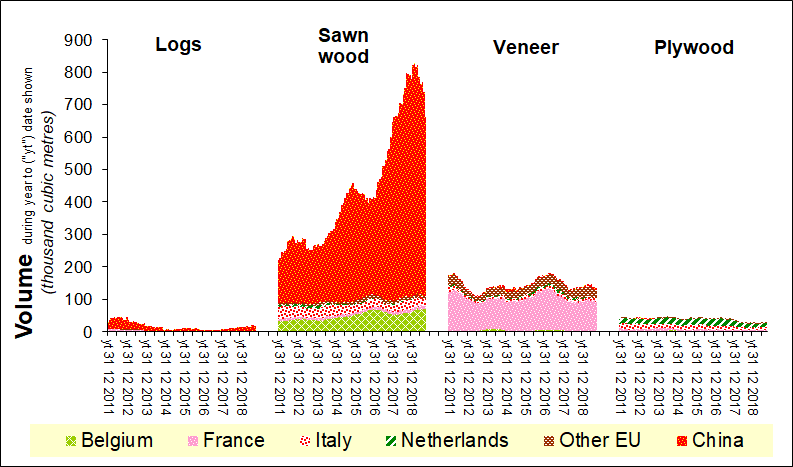
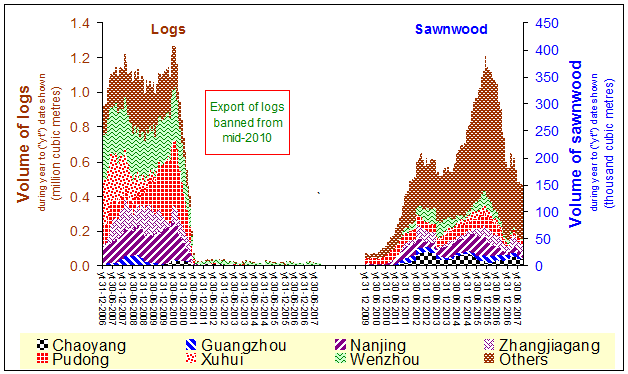
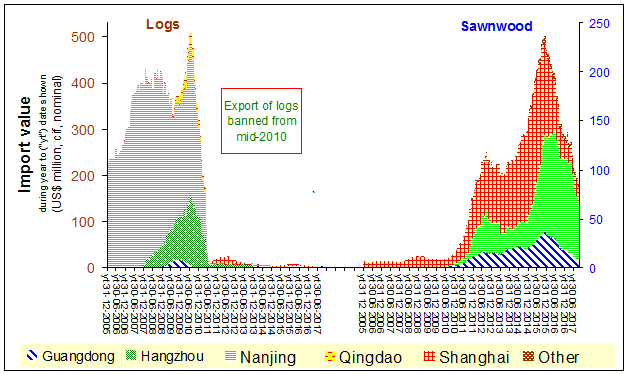
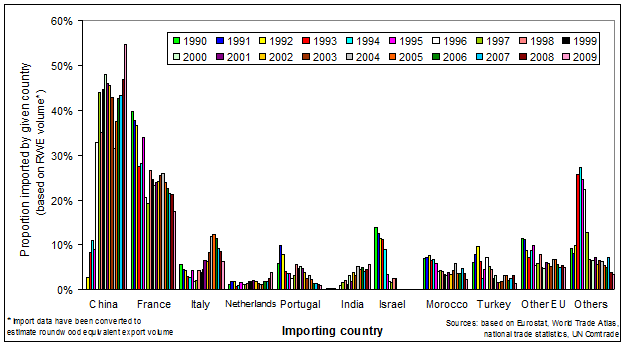
The export of logs has been prohibited since May 2010, no doubt partly because so little progress had been made by a major group of interests (predominantly Chinese and Malaysian) towards meeting the earlier policy objective concerning the milling of logs in Gabon prior to export. Given that China imports a negligble quantity of sawn wood, veneer or plywood from the range states of okoumé, it is likely that all furniture, plywood or other wood-based products which have been made in China at least partly from okoumé are likely to be illegal - and possession of it illegal (in the USA and, from the third of March 2013, the EU). Sales to China have boosted the cash flow of a number of those long established (largely French and, more recently, Italian) companies and made progress towards their operations' sustainability easier to finance. In contrast, China (despite dominating the market for Gabon's logs since 1996 and having huge foreign exchange reserves which are loosing value in the USA) has shown no interest in supporting efforts towards sustainable forest management (i.e. compliance with the law) by enterprises which supply the great majority of its imports of those logs. The Rimbunan Hijau group (a multinational based in Sarawak, whose founding family is from Fujian, China) operates in Gabon under various names[p12] including Bordamur and, since 2007, "IFK" Industrielle et Forestière du Komo) and is understood to serve as a contractor for a number of other concessionaires (both large and small) including those at the highest levels in Gabon. Such practice, "fermage", has been illegal and particularly prevalent in the coastal region (where concessions are reserved for nationals of Gabon). It seems that documents co-opted as the forest management plan of IFK were prepared several years ago as part of the controversial South Estuary project supported by the World Bank which pertained to land adjacent IFK's concession. Prior to the ban on log exports, the Rimbunan Hijau group was one of the largest logging enterprises in Gabon and probably the leading supplier of Gabon's exports of logs (particularly okoumé) to China Whether or not they remain active, there is little published information about the Malaysia logging groups which entered the market in Gabon with Rimbunan Hijau during the mid-1990s. Chinese companies now account for a substantial proportion of the area allocated as major concessions. It is not clear whether these enterprises' entry into the sector reflects a desire to break the quasi-monopoly of the Malaysian groups in the supply of timber to China. Through profit sharing agreements, their business might also serve to supplement the interests of Gabon's elite as a quid quo pro for the latter's complicity in neglecting the social and environmental impact of China's exploitation of Gabon's mineral and marine resources - and the loss of long-term national wealth which that exploitation implies. Hua Jia (a subsidiary of China International Forestry Group Corporation, a Chinese, state-owned timber company which had no experience of tropical forestry) whose forest inventory and management plan for its 400,000ha concession were officially approved during 1999. However, it seems that the documents approved comprise little more than the output of a study covering only 108,000ha carried out on behalf of the ITTO during the early 1990s (completed in 1996) - which the ITTO itself describes as fundamentally unsuitable (not least because it excluded key stakeholders, ignored the social and ecological impact of logging operations, and did not include an operational management plan). COFCO one of China's largest state-owned food-stuffs groups - which includes subsidiaries who trade in timber from Burma, Oceania and elsewhere (whose exports are characterised by Illegal Timber) - has recently acquired (and consolidated the rights to) an area of forest concessions 40% greater than the maximum permitted by law [article 147] (and more than any other concessionaire in Gabon). The group has no experience of sustainable tropical forest management and its plans seem to exclude assessment of the environmental impact of its logging operations. It appears to operate in Gabon as Sunly, Sunry and SAFOR. Saina, the entity which has acquired the concessions on behalf of the group, plans to export 300,000m3 of logs from Gabon each year, including for use by Dalian Tuhsu Fuviger which makes wooden flooring for group. [COFCO appears to be a leading advocate of converting forest and "unsuitable" other land for use as biofuel, both from jatropha and foodstuffs. In so far as that land is already being used to produce food (or could do so, particularly with similar levels of investment, subsidy and high level support as would be provided for the production of jatropha and its manufacture as fuel), COFCO's interest will tend to increase food prices in China and, particularly given food shortages, might lead consumers to boycot the firm's products in response - offsetting any increased profit which the firm might earn from those increased prices.] During 2003, a Chinese enterprise - Honest Timber - seems to have acquired 200,000ha of logging concession. It is based in Zhangjiagang, a port town which accounts for the majority of China's tropical timber imports. Its owner, Guohua Zhang, was arrested in Gabon during 2010. The acquisition of Leroy Gabon, Pogab and Plysorol by an affiliate - Shandong Longsheng - has reduced the ability of the veneer industry in Gabon and the plywood industry in France to compete against supplies made in China by severely reducing the availability of logs to both Leroy Gabon and Plysorol[-]. Plysorol (previously the largest manufacturer of plywood in Europe)[-], is now in receivership (in breach of undetakings given by the Chinese group [p35]) and the forest assets of its former parent (SONAE) have been transferred (presumably illegally) to a previously unknown entity Concours Bois [-] - presumably in order to deny the receiver access to them. The Chinese group now seems to control an area of concessions well in excess of the maximum permitted in Gabon. It seems that these Chinese enterprises fail to comply not only with government of China regulations concerning companies operating in the forestry sector overseas but also with the law in Gabon. Products made from their logs are unlikely to be deemed either acceptable under the EU's proposed Due Diligence regulation or compliant in relation to the Lacey Act in the USA. By 2012, established concessionaires should mill at least 75% of their logs within Gabon [article 227]. Quotas for the export of logs were introduced during 2007 - but appear to have had little impact on trade (see monthly statistics above). The World Bank [§19 & 20] considers that Gabon's timber industry has been of little benefit to Gabon and that the great majority of that part of Gabon's forest estate which is commercially attractive is allocated as logging concessions. The list of concessions current during May 2007 excludes several concessions which the government was obliged to withdraw after an exposé of those which were in default [§20 to 28, also VIII], particularly in relation to non-payment of taxes (due from as much as roughly 60% of the area of Gabon's logging concessions, including those of the ruling elite). There appears to have been little trade in certified timber from Gabon despite the evolution of a number of certification schemes, the most recent of which has PEFC endorsement. Ensuring the chain of custody through mills is a particular (but simple) challenge given the law concerning the maximum proportion of an enterprise's production that can be exported as logs - a little care will be needed to avoid double counting of timber originating from other concessions. Okoumé - used primarily in plywood and confined almost entirely to Congo (Brazzaville), Equatorial Guinea and Gabon - is much the most exported species in Africa. Of the region's natural forests, those rich in Okoumé are probably the only one's which can be managed sustainably at anything like the current excessive rates of extraction. Over-exploitation of okoumé seems most prevalent in Equatorial Guinea and southern Congo Brazzaville. The average quality of Gabon's okoume forest is declining and logging appears to exceed what the government deems the maximum sustainable rate of extraction.. Although Gabon is the leading exporter of okoumé, it is also a major exporter of other commercial species - a number of which are endangered by over-exploitation and, like okoumé, seem now to warrant listing under CITES. The price of okoumé altered very much less than one might expect when demand (driven by China) rose so fast and far in the mid-1990s. However, a price increase would have affected the profits of okoumé processing companies in France. Further, the 50% devaluation of the CFA franc against the French franc (in 1994) seems to have had no effect on demand for okoumé in France. Exports of okoumé logs (which account for roughly two thirds of Gabon's exports of logs) were until recently controlled by a state marketing monopoly SNBG - which had served the vested interests of ruling elites since before the end of the European colonial era. The difference between that era and this century - dominated by China - remains to be seen, particularly given concerns about the impact in Gabon of onshore extractive industries and associated infrastructure sponsored by China. Forest conversion projects in Gabon - particularly for export-oriented industrial-scale exploitation of rubber and palm oil - are generating controversy. Further information: |
||
|
Copyright
globaltimber.org.uk
|