|
|
|||||||||||||||||||||||||||||||||||||||||||||||||||||||||||||||||||||||||||||||||||||||||||||||||||||||||||||||||||||||||||||||||||||||||||||||||||||||||||||||||||||||||||
|
|
|||||||||||||||||||||||||||||||||||||||||||||||||||||||||||||||||||||||||||||||||||||||||||||||||||||||||||||||||||||||||||||||||||||||||||||||||||||||||||||||||||||||||||
|
Congo (Brazzaville) |
|||||||||||||||||||||||||||||||||||||||||||||||||||||||||||||||||||||||||||||||||||||||||||||||||||||||||||||||||||||||||||||||||||||||||||||||||||||||||||||||||||||||||||
|
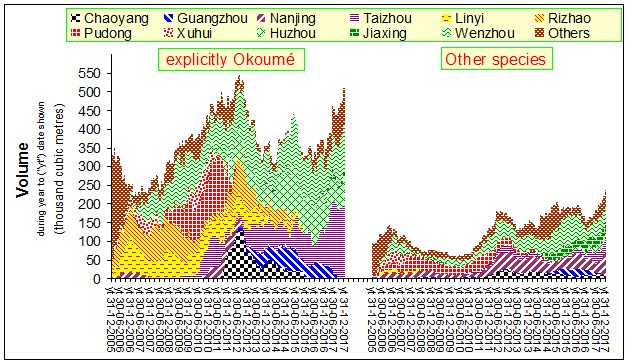
Imports
of logs from the Republic of Congo (Brazzaville) declared by China
Source: China Customs
|
|||||||||||||||||||||||||||||||||||||||||||||||||||||||||||||||||||||||||||||||||||||||||||||||||||||||||||||||||||||||||||||||||||||||||||||||||||||||||||||||||||||||||||
|
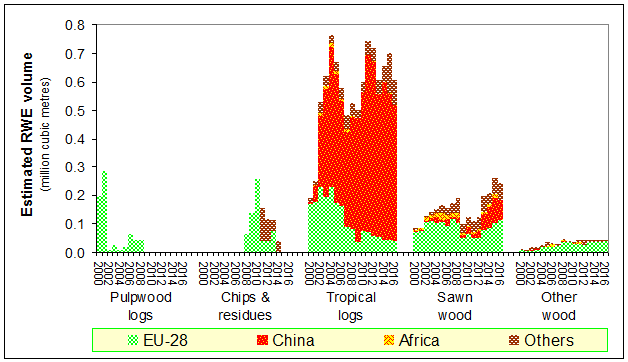
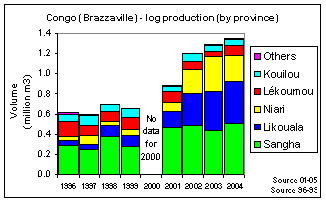
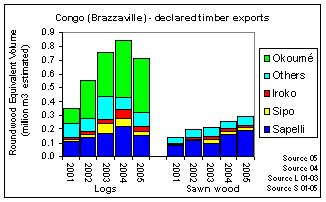
Since May 2012, it seems[-] that the rights to export logs have been withdrawn from several logging groups (mainly Chinese). Nevertheless, a number of these continued to export - and one, which appears to control the supply of almost all the logs which China imports from Republic of Congo[p7], increased its supplies. At least some of these logs have arrived in the EU, perhaps with the hope of being placed on the market before Regulation 995/2010 comes into force (on 03 03 2013). The decline in China's imports from the fourth quarter of 2012 indicates that the government of Republic of Congo has had some success in enforcing its legislation. Roughly two thirds of the quantity of timber which was exported during 2008 from the Republic of Congo through Cameroon (i.e. from the northern forest region) derived from logging concessions whose management is now FSC-certified. The great majority of this is probably destined for the European Union. The majority of timber exported from the south is probably illegal. Indeed, all okoumé logs which China imports are likely to be illegal. Consequently furniture, plywood or other wood-based products which have been made in China at least partly from okoumé are likely to be illegal - (China imports a negligble quantity of sawn wood, veneer or plywood from the range states of okoumé). One enterprise making veneer from okoumé claims that it accounts from more than half the volume of okoumé which China imports from Republic of Congo. During May 2009, the country signed a Voluntary Partnership Agreement "VPA" with the European Union to ensure that only legal timber would be exported from Congo (Brazzaville) to all destinations, not just the EU[p2]. If implemented, it would exclude roughly 85% of the tropical logs currently being exported from the country's southwestern forests - implicitly at least 85% of the timber which the country exports to China, Congo (Brazzaville's) main market. Despite this, the volume of logs which China imports from Congo (Brazzaville) has increased, particularly since Gabon prohibited the export of logs (which has for many years been the intention of its forest policy). However, subsequently, a large logging concession (Tsama, 235,000ha) was allocated to an enterprise run by the President's daughter [Kelly Christelle Sassou-Nguessou]. She was granted a further large concession (Mbama, 357,000ha) during 2010. During 2009, a subsidiary (China Foma) of Sinomach (formerly a machinery manufacturer of China's State Forestry Administration) secured an interest in processing timber for her. This tends to confirm that the proposed VPA is a farce. During 2009, SCTB (Société Congolaise de Transformation des Bois) aquired what remained of ITLB (Industrie de Transformation des Bois de la Likouala) [p677], including a very large logging concession (Mbomo-Kellé, 613,000ha). It has subsequently been granted a further concession (Enyellé-Ibenga, 352,000ha), previously allocated improperly[p19-21] to Million Well Congo Bois. Although it is claimed (early 2009) that the export of okoumé has recently collapsed, the trade statistics above indicate no such change. Indeed, the quotas supposedly set for the export of logs appear to have had little impact on actual trade, making calls for a 15%-30% increase in quota remarkable.†‡ The country's timber industry appears have split into two - concessions which are being operated within the sprit of the law (generally, but not exclusively, in the North) and those (oriented primarily to the supply of timber to China) which are not. Indeed, due partly to civil war (in which Congo's current ruler seized power), forest management in the south is such a shambles that, in an Annexe, the ITTO during 2000 recommended a halt to current exploitation there and that major forest concessions should be reallocated as single units rather than as a set of smaller units. Subcontracting of logging is a particular problem in the south, in effect enabling a logging subcontractor to evade the procedures which would be legally required if it had been directly awarded the whole concession. Although the Law (of 2000) requires that 85% of logs be milled prior to export, exporters can pay a special fee in order to waive this requirement.[III (3) (ii), §42] [-] Instead of a quota, the new Code Forestier (of 2020) allows the export of logs if they are of heavy, hard species which require special technology to mill them. However, the law does not list those species or describe that technology - which might be a single saw blade! Clearly, a major loophole. That loophole is symptomatic of the new Code Forestier - many clauses are subject to ministerial discretion (implicitly corruption, supposedly a central component of the VPA). This will presumably be a major impediment to due diligence by those who import timber from Republic of Congo. Given its work as logging subcontractor in Equatorial Guinea and probably Gabon, it is likely that the Rimbunan Hijau group provides such services in Congo too (notably as Taman Industries, through SOFIL and CIBN). Taman Industries' main operations appear to be in the Chaillu massif (especially Niari province). It is understood that the group has been allocated at least one concession by Presidential Decree. Presumably this presidential interest enables concessionaires to operate outside the law. Perhaps this is why, with the knowledge of local officials, a number of concessions in which Taman has an interest are being logged illegally in relation to many aspects of the law - particularly in excess of annual allowable cut. A number of other purportedly Chinese enterprises, a number of which appear to be front companies or to have little if any experience of tropical forestry, seem to have acquired a large area of concessions in Congo's southern forest region, notably Sino Congo Forêt - formerly Man Fai Tai and STCPA Bois - and Asia Congo Industries. SiCoFor alone has five concessions totalling 800,000ha. Although, during mid-2012, a number of Chinese and other logging groups (particularly Taman Industries) were ordered to suspend the export of logs, this order has had little impact on the volume of logs being reported by China as imports from Congo. The etablished Chinese group Vicwood (whose target markets include the USA) has a concession in northern Congo and holds the largest area of concessions in Cameroon and Central African Republic. Rimbunan Hijau is said[p7] to be supply the great majority of the logs which is imported into China from Congo - presumably acting as an agent for at least some logging companies other than those which it controls. It appears that the owner of SiCoFor (who was the Honorary Consul of the Republic of Congo in Hong Kong and owner of Man Fai Tai and China Overseas Development) was prosecuted for financial fraud during 2007. Nevertheless, the company has diversified, as Brilliant Ventures ("BVAL"), into mining in the Chaillu Massif. SiCoFor has links [p10] with another enterprise which has a logging concession, Congo Deija Wood Industry (which may have links to door manufacturing in China). The latter is logging UFA Kellé without an approved management plan. The two have become notorious for forest crime not only in Republic of Congo but also for their links in Gabon.[-] It appears that Asia Congo Industries is linked to Atama Plantation. Atama Plantations is a subsidiary of Wah Seong (listed on the Kuala Lumpur Stock Exchange). The managing director of the former seems to be managing director of the latter [-] [p9] [-] [-]. However, this is denied by Wah Seong[-]. Wah Seong has been allocated land for conversion to palm oil plantation(s) Clearance for the plantation[p14] has started, but inspectors allege that this has involved illegalities[p28] and it seems that a mandatory environemantal impact assessment has not been carried out let alone respected; as a consequence, there is a risk that the output of the plantations will be deemed illegal. The plantation is said to be the largest in the Congo Basin - despite the company's apparent lack of relevant experience. Wah Seong has links with a large Malaysian property group IGB Corporation (through shareholdings and common board members) The majority of the timber which China imports from Central Africa and the okoumé in most of the okoumé plywood which China exports (including that used in making furniture) is likely to be have been logged by the Rimbunan Hijau group. It is said that that group controls almost all exports of logs from Republic of Congo to China[p7]. Given that the USA alone accounts for the majority of China's exports of illegal plywood and wooden furniture, end-users in the USA might unwittingly be complicit in the business and logging practices of this group. Managament plans, required by law, have been carried out on none of the concessions in the south west (except Nouvelle Trabec) or in the far north west (e.g. SEFYD)[p3] - the regions which have the greatest Chinese/Malaysian presence.[p19]. That government has not urged a single concession company in the southern region to do so [§1 right p3] would be consistent with corruption at the highest levels - as would the improper granting and transfer of concessions [see Million Well Congo Bois and SiCoFor (/ Man Fai Tai) [p2]. SEFYD's concession is in area renowned for elephant poaching.[cell D211 of sheet Year 1 Workplan]. China is a leading hub for trade in (illegal) ivory. Timber production (particularly of okoumé) has increased very rapidly in the Chaillu massif (in contrast to the more modest growth sic elsewhere in Congo) in part because a new road (suitable primarily for logging vehicles) has been constructed (on behalf of Taman Industries) giving further access to the region's forest. The increase might also reflect a lack of adherence to a properly designed and approved (and legally required) management plan. According to the FAO, the Chaillu region has to some extent been stripped of commercial species, particularly okoumé - the species which accounted for 280,000 of the 360,000m3 increase in Congo's log exports between 2001 and 2005. This begs further questions about whether most of China's timber imports from Congo (which primarily comprise okoumé logged by or for the Rimbunan Hijau group) are sustainable and legal - sustainable forest management being a fundamental objective of Congo's forestry code. Probably the only way to protect Congo's okoumé population (like that in Equatorial Guinea) from exhaustion is to list this species under CITES - Appendix III if Gabon is willing to propose it, otherwise Appendix II. Since the civil war, China has become a leading destination for Congo's oil (a close second behind the USA during 2006), timber and other natural resource exports. China has and is providing Congo white elephants and infrastructure projects at least some of which are redundant (notably for hydro-elecric power, - the existing Inga HEP could supply most of Congo's electricity consumption) and probably none of this "aid" takes social and environmental impact into account. Such projects tend to use imported labour and materials - adding little value to Congo, tending to induce Congo to comply with China's requests, and probably encumbering Congo with debt. Although Congo's export statistics might appear healthy, although the political elite is prospering, such taxation as is properly collected from that trade appears to be of little benefit to the nation - and the concentration of wealth is adding to political instability. Much to the apparent concern of the IMF and others, Congo has already mortgaged much of its future oil revenue - not just to China - at prices and through mechanisms which are unlikely to enable Congo's impoverished people to benefit from that trade for the foreseeable future. China is believed also to have become significant as a supplier of weapons to Congo. One of the most dubious schemes in the Congo Basin's timber sector is that being promoted by a group of Malaysian, Korean and Emirati enterprises with names such as "Malaysian Korean Resource Consortium" to construct a railway in Congo, initially between Ouesso and Brazzaville via Djambala and perhaps subsequently from Djambala to Pointe Noire. In addition to mining concessions, the promoters will benefit from logging concessions (UFAs Mbomo and Kellé) whose durations would be significantly less than consistent with sustainable forest management. The concessions appeared to have been awarded provisionally less than one year previously to its sole bidder, Congo Deija Wood Industrie (purportedly of China and also active in Gabon). The scheme, particularly its first phase, is unlikely to benefit Congo; - Brazzaville has for several years effectively had no rail or road links to the coast and the Transgabonais railway (in Gabon) is never expected to generate a profit, despite directly serving a larger forest and mining area - particularly if logging starts in advance of the railway being built. Although the IMF is keen that Congo's forest revenues are monitored, the 40% of those revenues which should be invested in the Forest Fund has been diverted by a Prime Minister's decree. China's interest in Congo is logs - not in processed timber - with which to supply its own large (export-oriented) plywood & furniture industry and may reflect the tightening up of the administration of Gabon's forestry/timber industry and diminishing availability in Equatorial Guinea. China now dominates Congo's timber exports - most of which should consequently be described as illegal, particularly if the supplementary tax payable on log exports in excess 15% [p5] of a concessionaire's log production is either not properly paid or set at too low a level. In principle, such a tax would enable greater utilisation of Congo's timber production - mill by-products tend to go to waste in Congo whereas they would be used in other wood-based products if the milling takes place in major markets abroad. Congo has the largest export-oriented plantations in tropical Africa. Be they of eucalyptus (for pulpwood) or native tropical species, the commercial viability of plantations in Africa is at best marginal - particularly given current levels of price and political risk. This makes rather counter-productive the rhetoric of the FAO and others that plantations will provide the solution to the growing imbalance between consumption and suitable local supply in tropical Africa. Congo's exports of pulpwood in effect ceased in 2002 (after the civil war, seemingly due to the interference of vested interests at the highest levels of government). After a dalliance with a (corrupt) South African black-empowerment organisation, the plantation concession has been acquired by a mining company which seems to have no experience of plantation management - the concession overlies the company's magnesium and potash mineral lease. Statistics of Congo's timber exports which have recently been published by the government include tables which are unusable and grossly misleading - different amounts being presented in different tables for the same parameters and China (the primary destination for Congo's log exports) is not named as a principal destination. This might be sloppy or reflect the difficulty which staff have in obtaining credible data from certain sources - neither of which give confidence in Congo's purported shift towards transparency. Further, very little of Congo's okoumé exports or exports to China appear to be recorded (through Pointe Noire's main port), begging questions as to which port Rimbunan Hijau's exports depart from and whether these are taxed and scrutinised in the same way as other timber exports from Congo. Such poor statistical information contrasts with the data which the company monitoring the export of timber from Congo has presumably compiled. †‡ [slides 4 & 7 "Crise financiere economique mondial secteur forestiere"] Further information: |
|||||||||||||||||||||||||||||||||||||||||||||||||||||||||||||||||||||||||||||||||||||||||||||||||||||||||||||||||||||||||||||||||||||||||||||||||||||||||||||||||||||||||||
|
Copyright
globaltimber.org.uk
|
|||||||||||||||||||||||||||||||||||||||||||||||||||||||||||||||||||||||||||||||||||||||||||||||||||||||||||||||||||||||||||||||||||||||||||||||||||||||||||||||||||||||||||